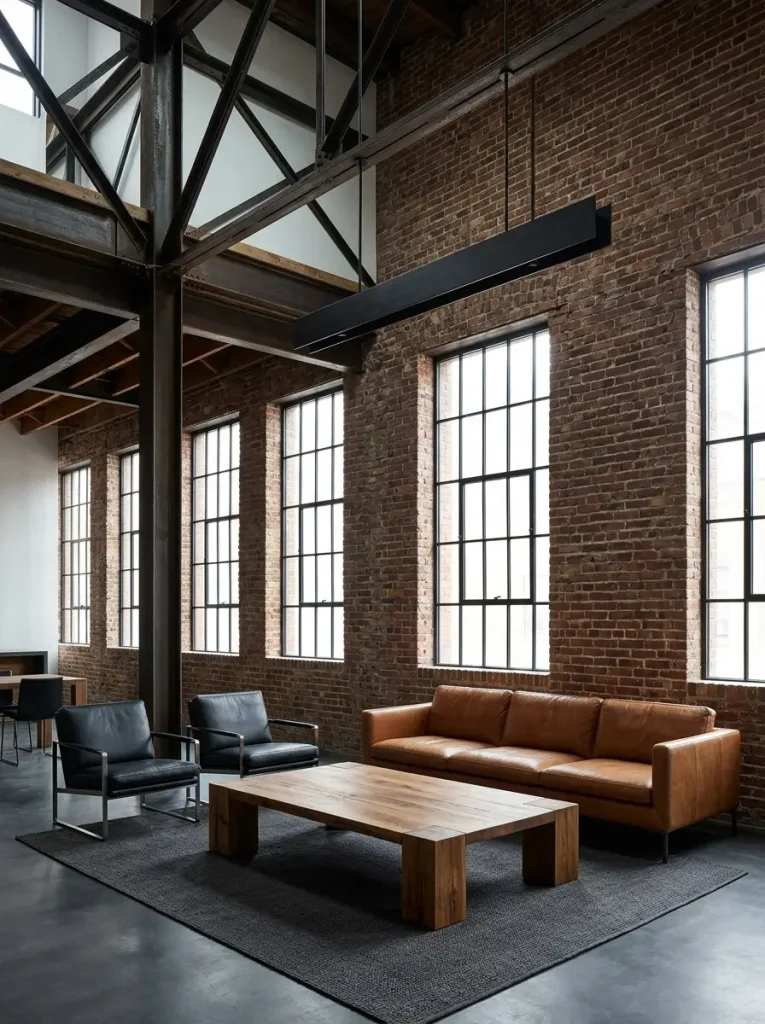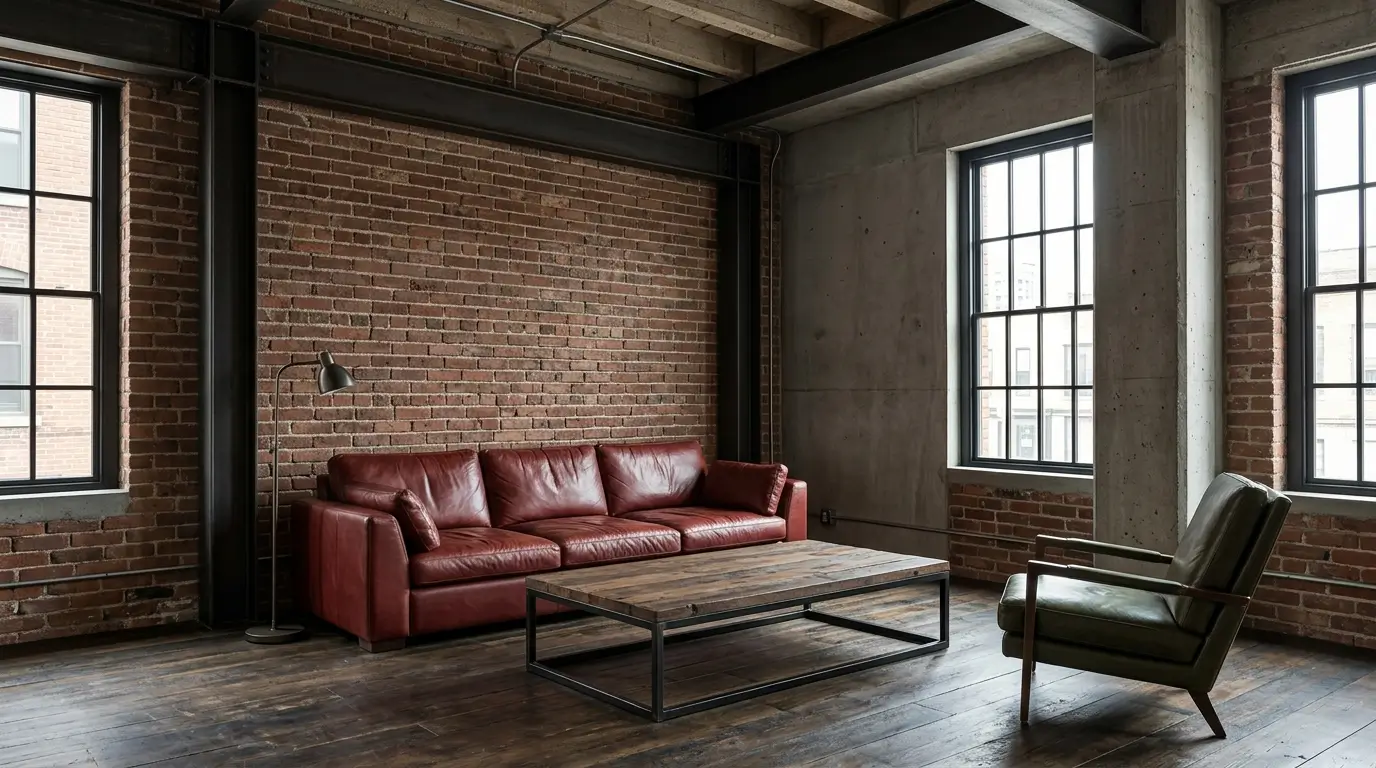
Industrial interiors are often reduced to a single familiar picture: exposed brick, black metal, and worn brown leather.
In practice, the style has considerably more range. Its strongest expressions come from the relationship between a room’s architecture, its materials, and the design intention behind the furniture and palette – and that relationship can be built in many different ways.
The industrial style living room ideas below demonstrate twelve genuinely distinct directions, from saturated color schemes and traditional furnishings to sculptural contemporary pieces and spaces defined entirely by their structure.
Together they show how flexible industrial design can be across lofts, apartments, and conventional family homes.
1. Color-Forward Industrial Living Rooms
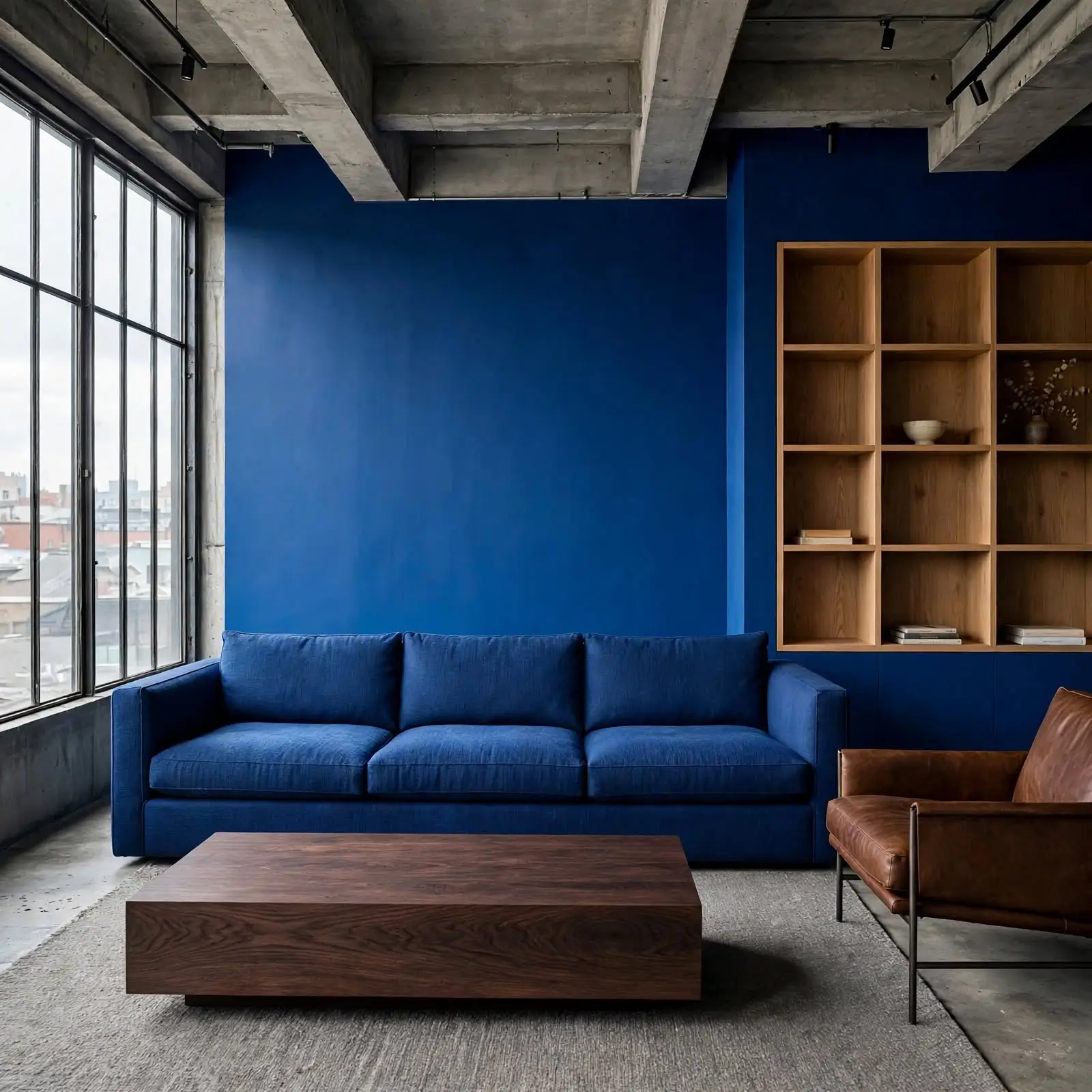
A confident color strategy can organize an entire industrial interior.
In a loft apartment with good ceiling height, walls painted in deep cobalt blue give the room a coherent identity, and a generously scaled sofa upholstered in the same tone extends the color across the middle of the space.
The industrial character stays legible through the architecture itself: steel-framed windows, a poured concrete floor, and exposed ceiling structure remain in neutral finishes so the color reads as deliberate rather than decorative.
Oak shelving adds warmth without introducing a competing palette. The lesson here is scale – color works hardest in an industrial room when it occupies walls and substantial furniture, not just cushions and artwork.
2. Dark Architectural Industrial Interiors
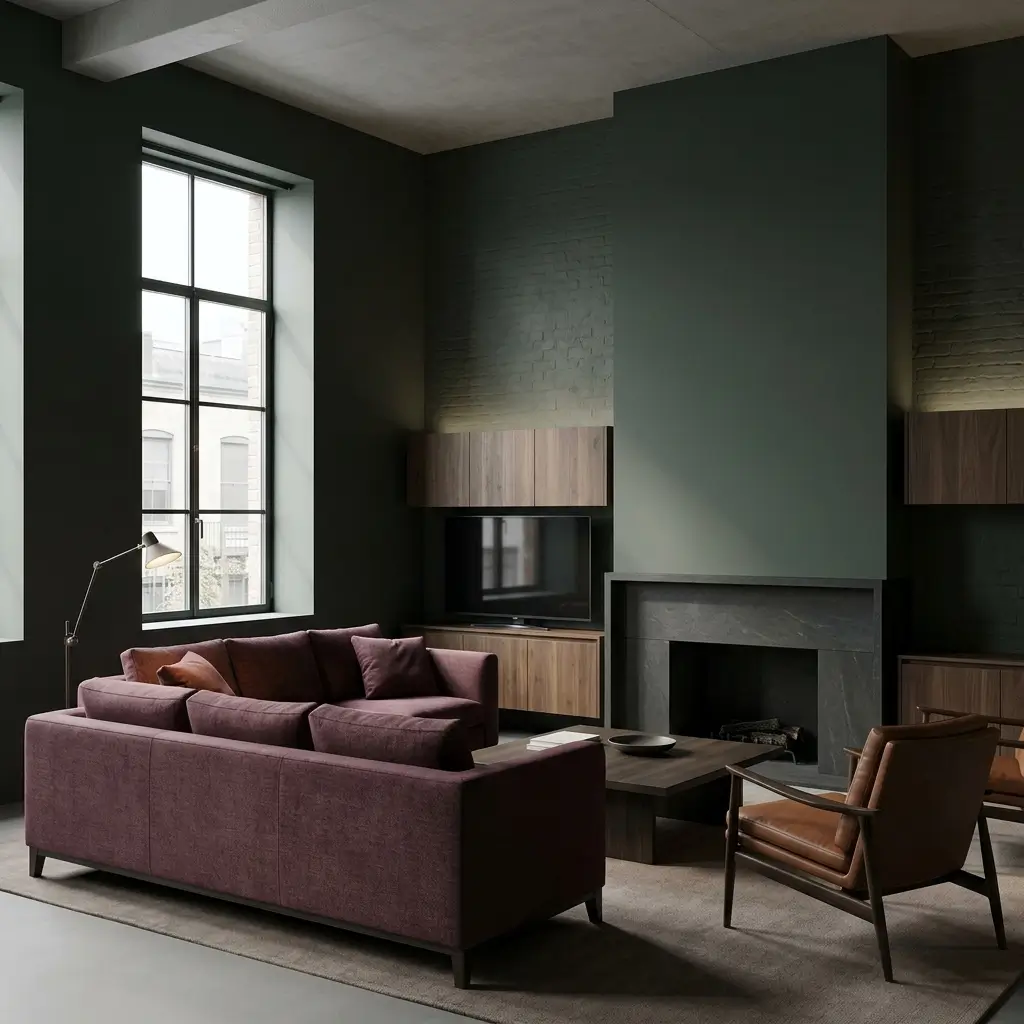
Deep charcoal-green walls, smoked timber, and dark stone give this interpretation substantial visual depth.
A tall window can bring daylight across the surfaces, revealing differences between matte paint, textured masonry, and the grain of the wood.
The furniture needs enough visual presence to hold its place against the darker envelope; a generously proportioned sofa in burgundy wool or muted plum can provide that weight.
Lighting deserves particular attention near seating and circulation areas. Wall-washing illumination or adjustable floor lights can reveal material texture without flattening the room into a uniformly dark interior.
3. Refined Industrial Luxury
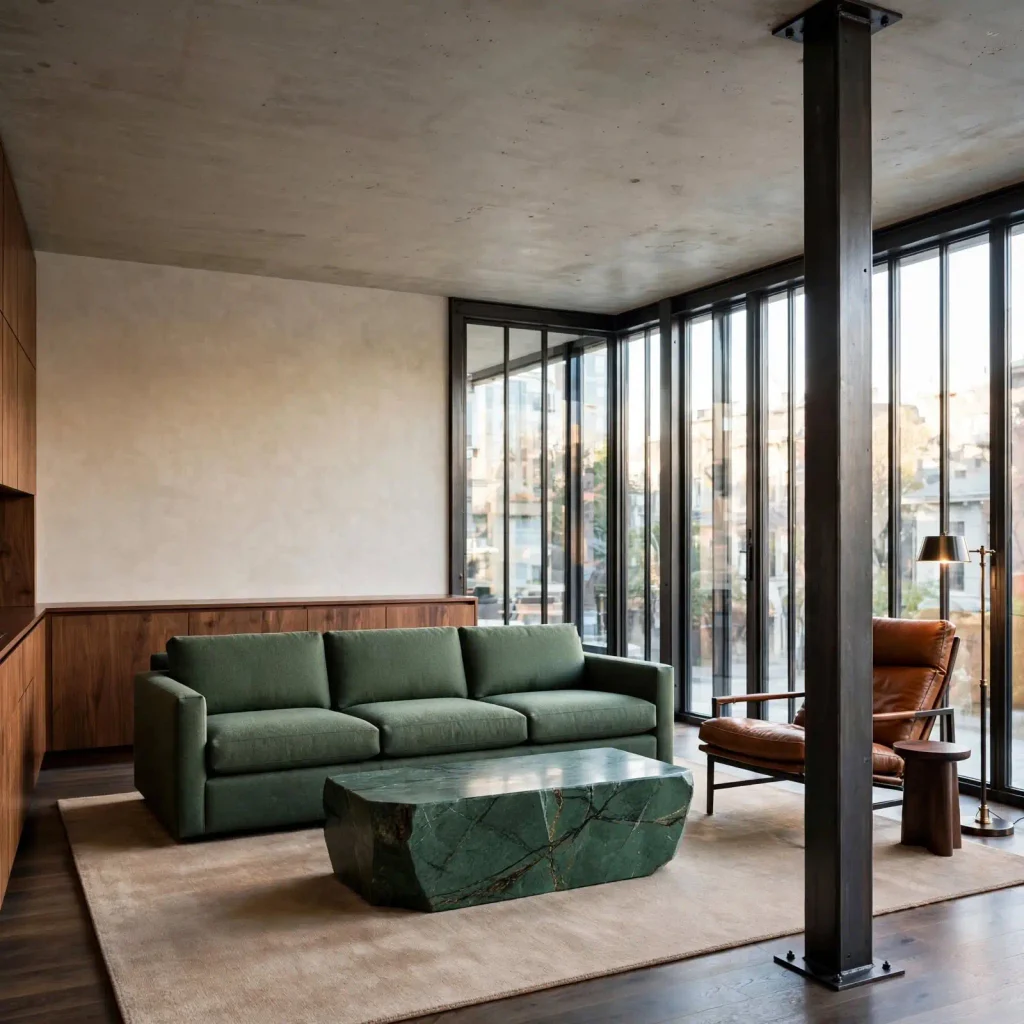
Here, precision and material quality define the industrial character.
A steel-framed glazing system and exposed structural column provide the architectural framework, paired with a tailored sofa upholstered in richly textured wool and a substantial green stone coffee table.
Walnut cabinetry adds natural grain, and brushed-brass details introduce a controlled metallic accent.
Each finish has a clear purpose, so the room depends on craftsmanship, proportion, and material integrity instead of decorative abundance.
Upholstery should feel substantial, with seams and silhouettes carefully resolved.
The distinction lies in how convincingly industrial structure accommodates furniture and finishes of a higher level of refinement.
4. Eclectic Industrial with Collected Character
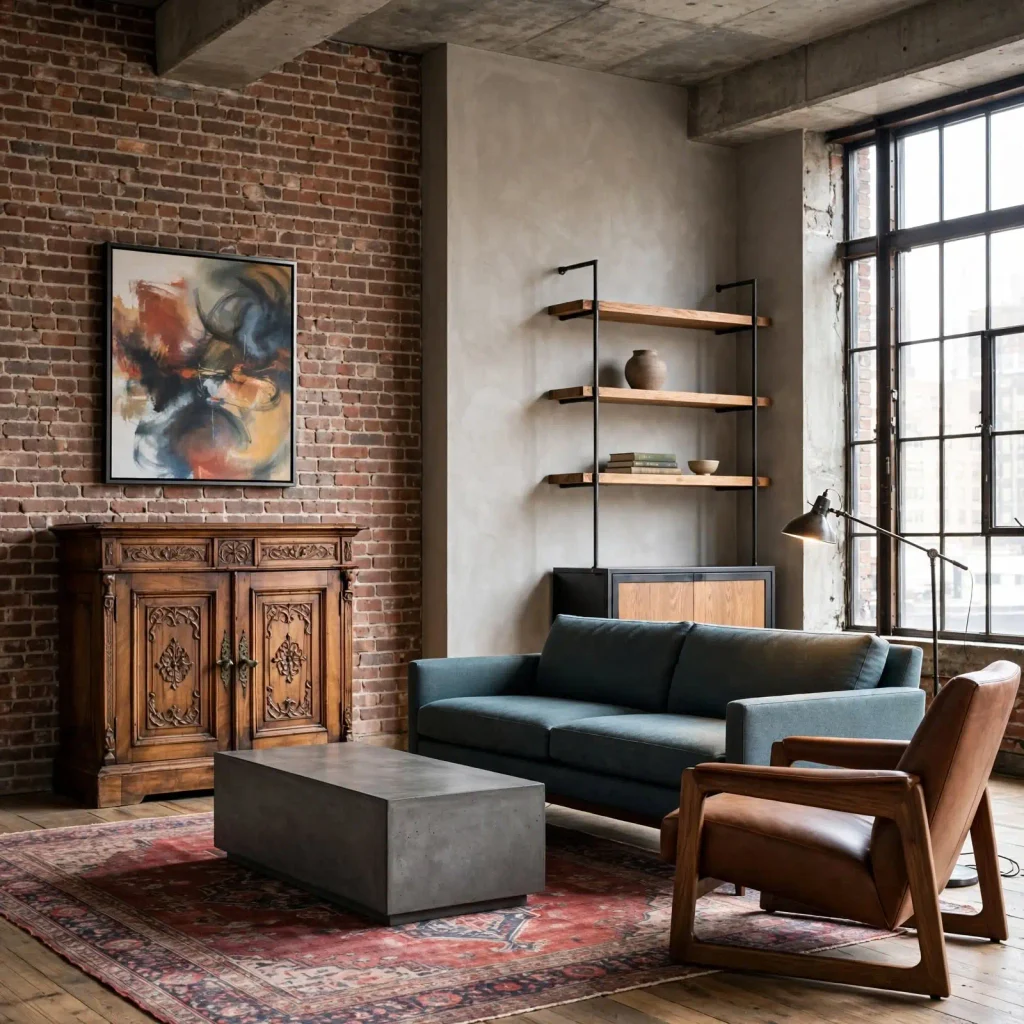
An eclectic industrial living room gains its personality from furniture belonging to different design traditions.
A contemporary sofa might sit beside a carved timber cabinet, an antique-style rug, and an expressive abstract painting.
The arrangement succeeds when the objects share a visual connection, such as related undertones, compatible proportions, or repeated shapes.
A faded red rug could link the cabinet’s warm timber to a modern upholstered chair, giving the assortment a coherent center.
Industrial shelving or a concrete surface establishes the underlying character. Each collected piece has room to contribute without turning the living area into an overcrowded display.
5. Minimalist Industrial Architecture
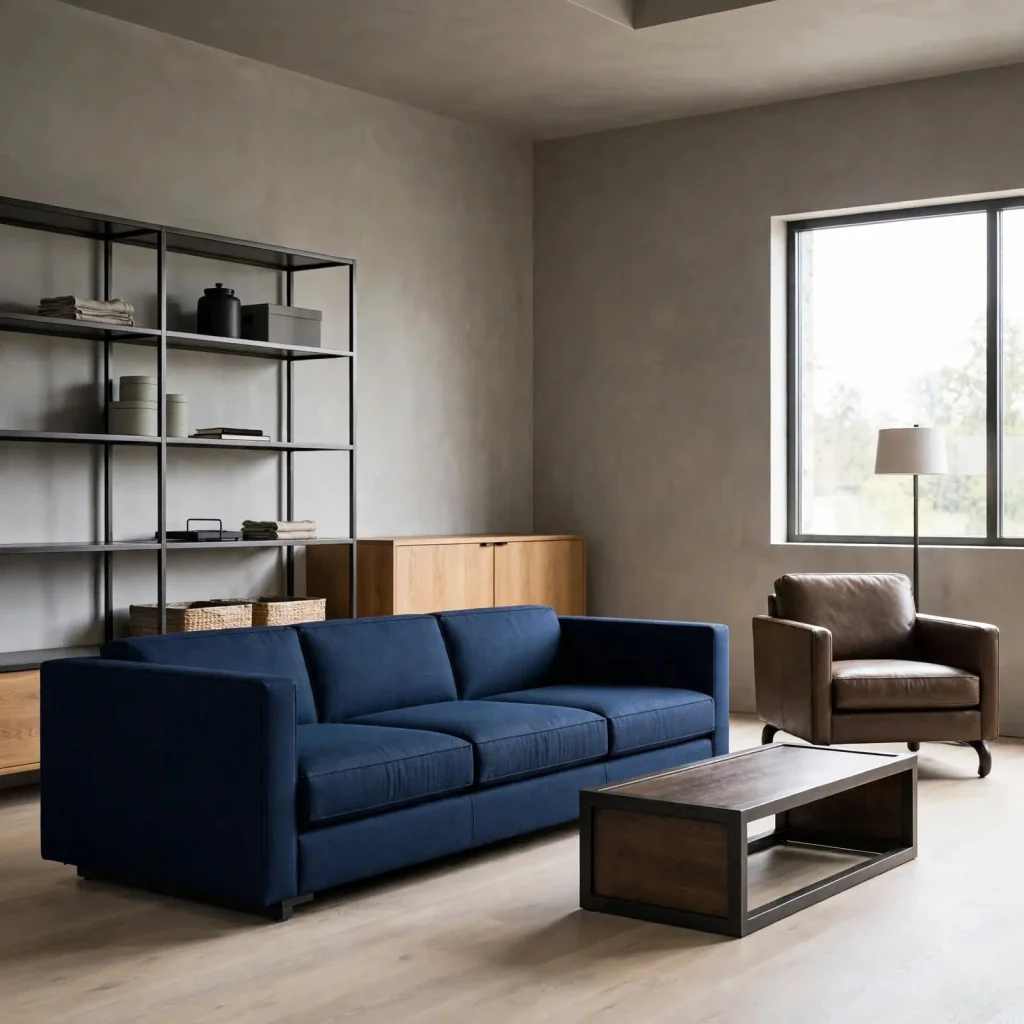
Minimalist industrial interiors rely on disciplined composition, clear geometry, and a limited number of well-chosen materials.
Consider smooth plaster walls, a pale ash-wood floor, a steel-framed shelving unit, and a single deep-blue sofa with a sharply defined silhouette.
The furnishings provide everything needed for comfortable living, and the open space around them allows their proportions to register.
Subtle differences between matte metal, fine-grained wood, and woven upholstery supply visual detail. Minimalism here is a deliberate arrangement of form and empty space.
The industrial quality comes from functional construction and material clarity, not from an absence of furnishings.
6. Traditional Industrial with Established Character
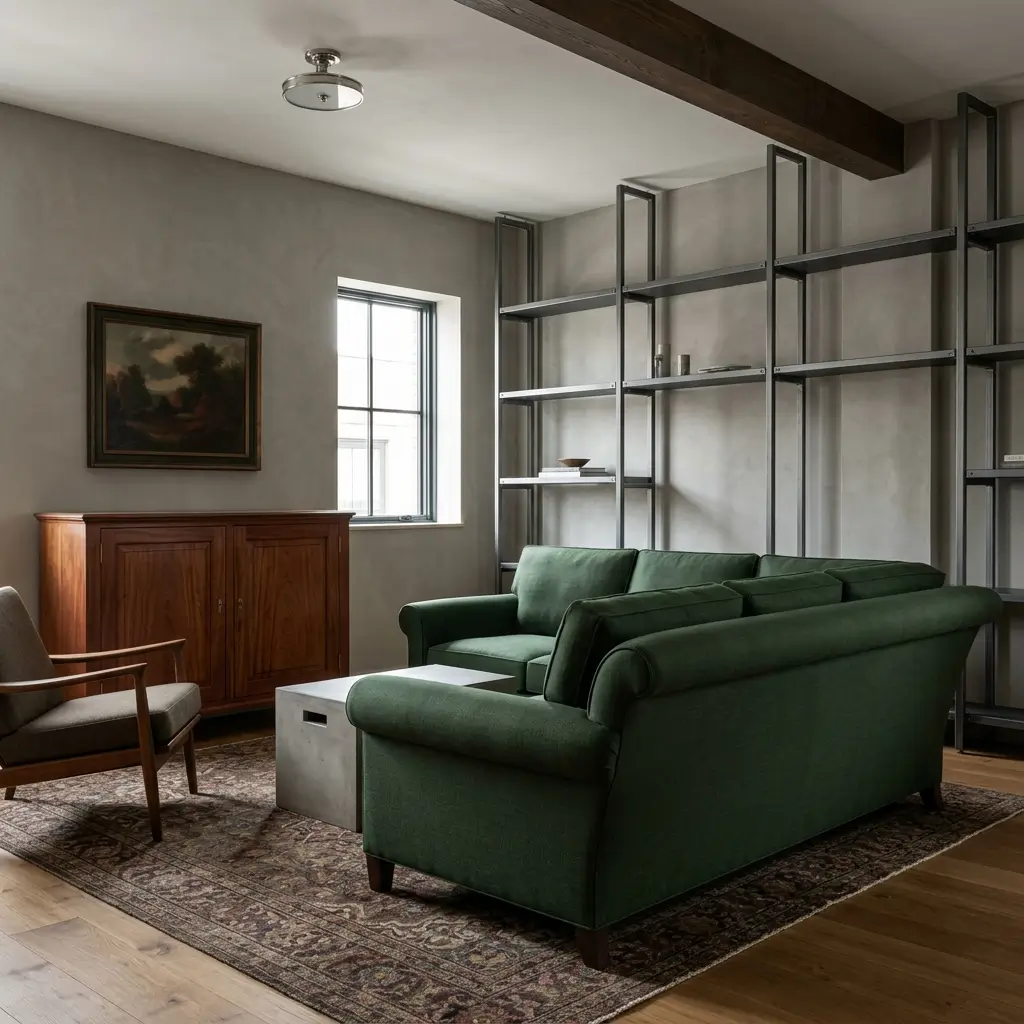
Traditional furniture forms give an industrial living room a more established identity.
A dark-green rolled-arm sofa, a patterned wool rug, and a substantial mahogany cabinet can sit comfortably alongside steel shelving and a simple concrete side table.
The furniture’s familiar proportions introduce a domestic character, and the industrial elements establish a more utilitarian framework.
A consistent undertone in the rug and upholstery helps the combination read as one interior. Classic artwork and a restrained arrangement of objects can complete the room.
The defining feature is the use of traditional furniture language throughout an otherwise industrial composition.
7. Structure-Led Loft Industrial
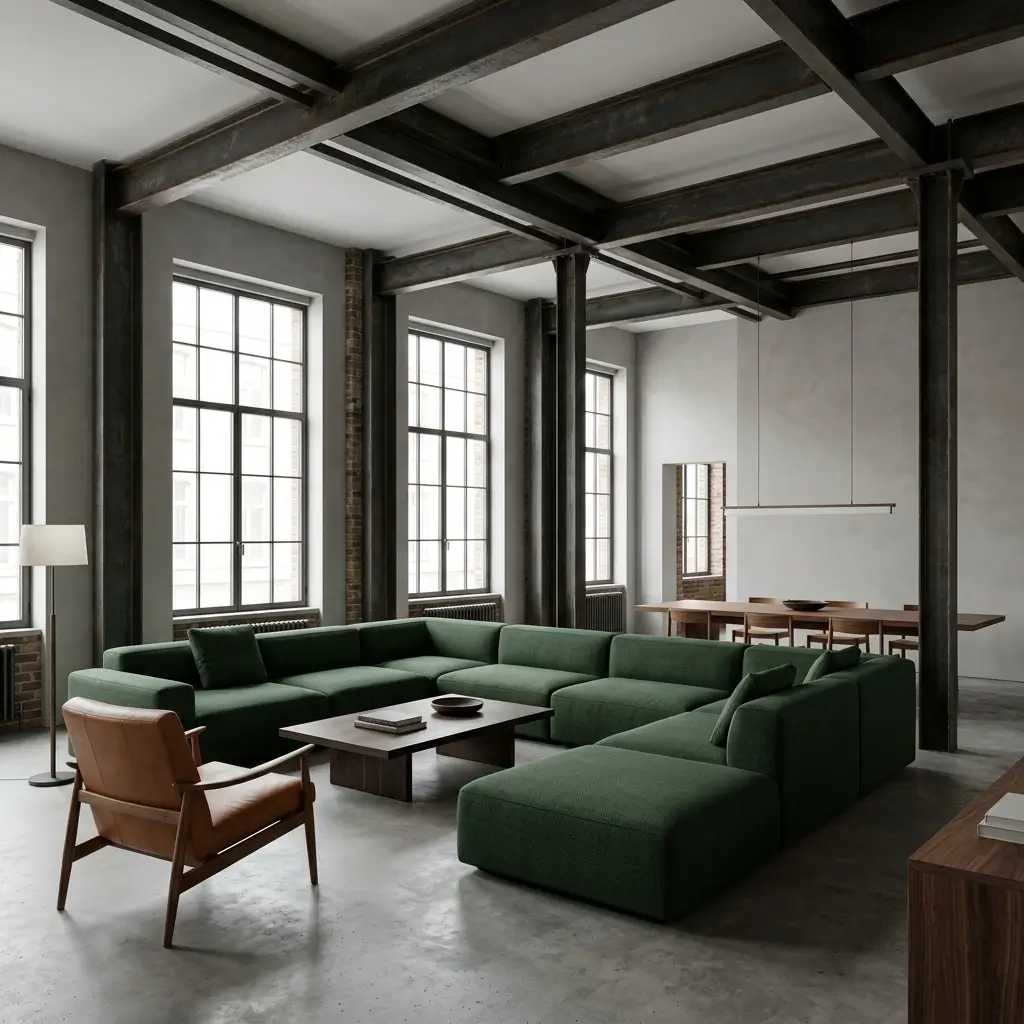
In a genuine loft or converted commercial building, architectural volume can determine the whole living-room arrangement.
Exposed steel beams, tall windows, and visible structural columns establish the spatial rhythm.
A large modular sofa can define the main seating area without interrupting sightlines across the open plan, with a long dining table or work area occupying the adjoining space.
The furniture must be scaled to the height and width of the interior; undersized pieces tend to disappear inside a generous volume.
Keep routes between seating, windows, and adjoining areas clear. Here, the building itself supplies the design’s strongest visual features.
8. Retro Industrial with Period-Inspired Furniture
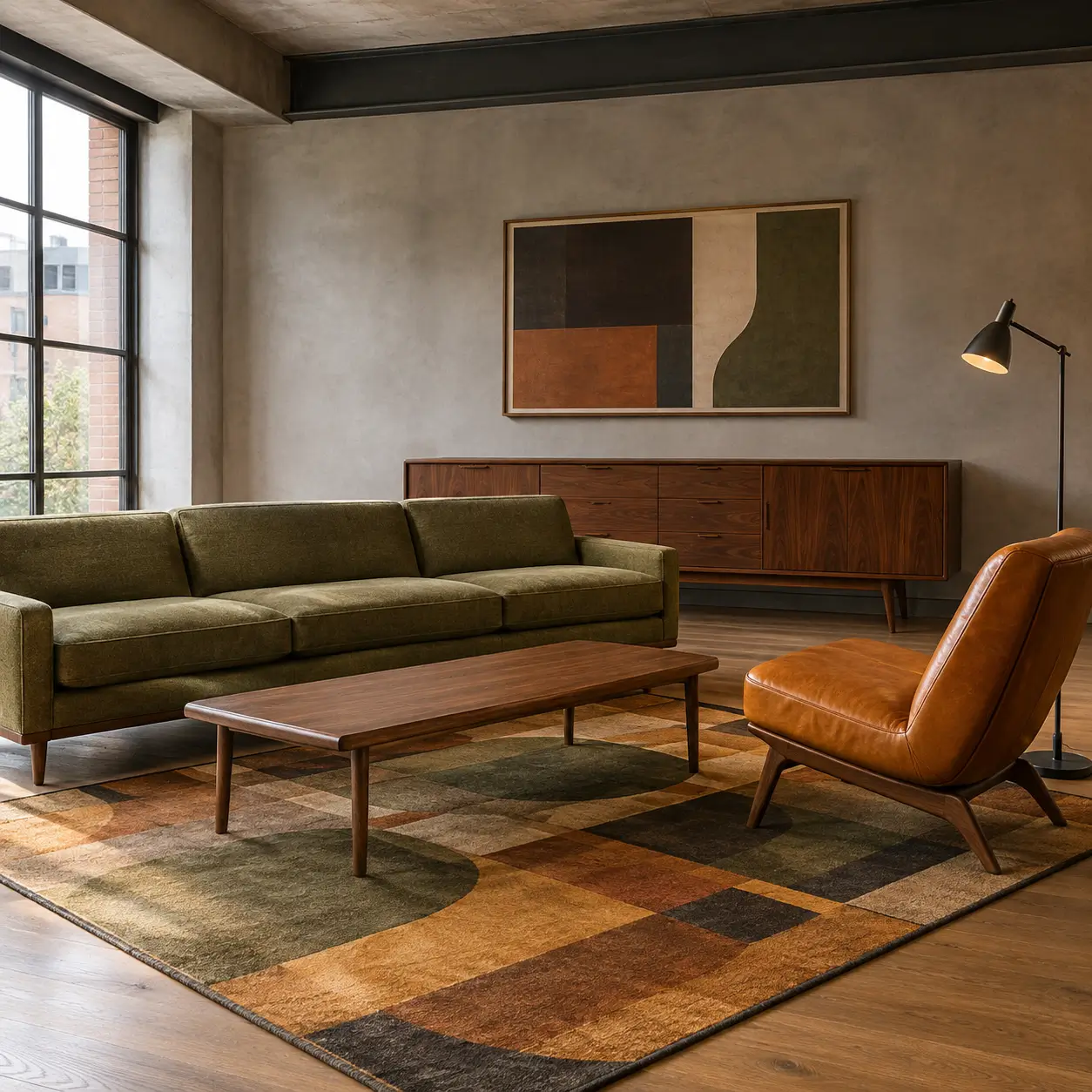
Connecting industrial materials with mid-century furniture silhouettes and period-appropriate color palettes creates a distinct design narrative.
Sleek tapered lounge chairs, teak cabinetry, and retro-inspired textiles introduce a warm, nostalgic quality that contrasts against industrial metal and concrete surfaces.
The chosen references form a unified design direction, avoiding random vintage clutter in favor of clean lines and intentional color pairings.
This approach demonstrates how industrial backdrops can accommodate specific historical furniture vocabularies while maintaining a crisp, contemporary edge.
9. Sculptural Contemporary Industrial
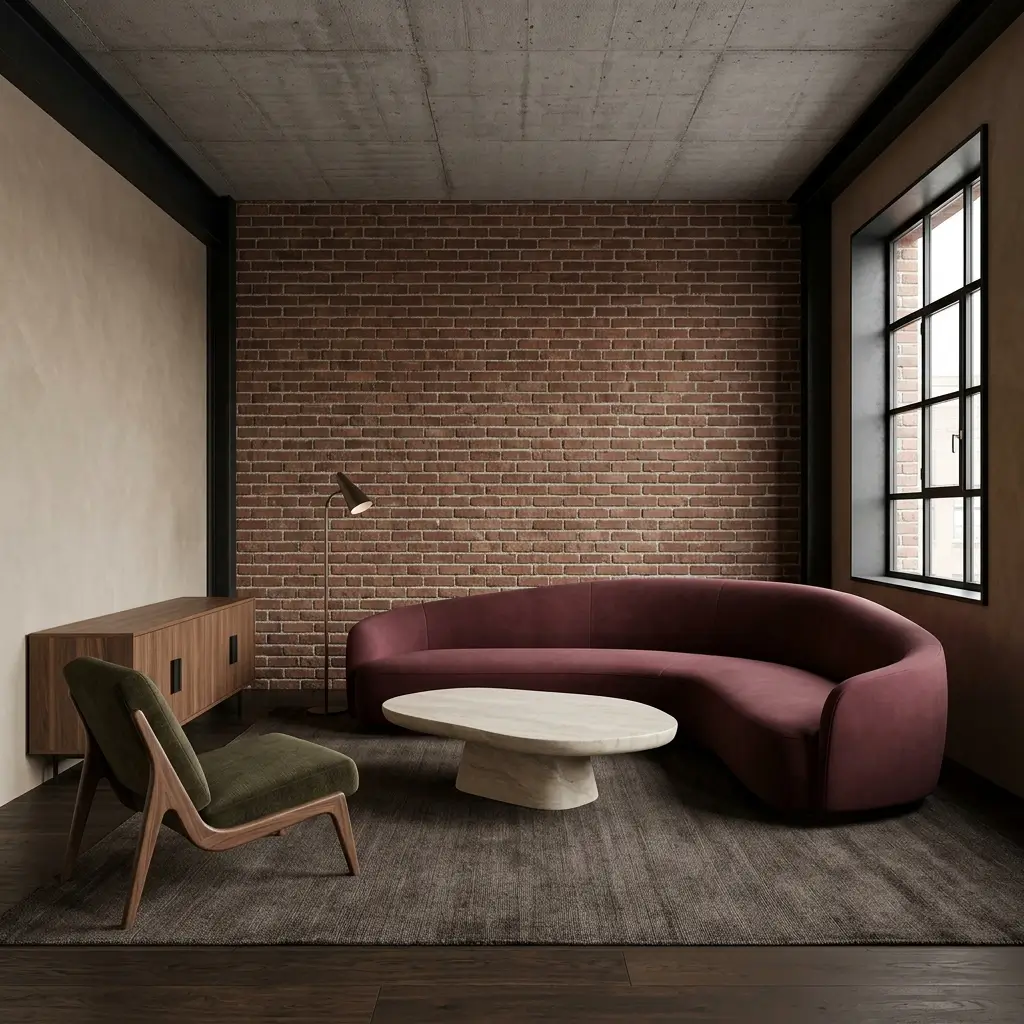
Contemporary furniture forms and sculptural silhouettes introduce dynamic contrast to the rigid geometry of industrial interiors.
An architectural sofa, a monolithic stone coffee table, or an unusually curved lounge chair breaks up linear sightlines while respecting the room’s foundational strength.
Curves and organic forms are introduced selectively to serve the composition rather than dominate it.
This balance between sculptural expression and industrial clarity creates a visually engaging living space where modern artistic forms soften the underlying architecture without diluting its character.
10. Heritage Industrial with Original Materials
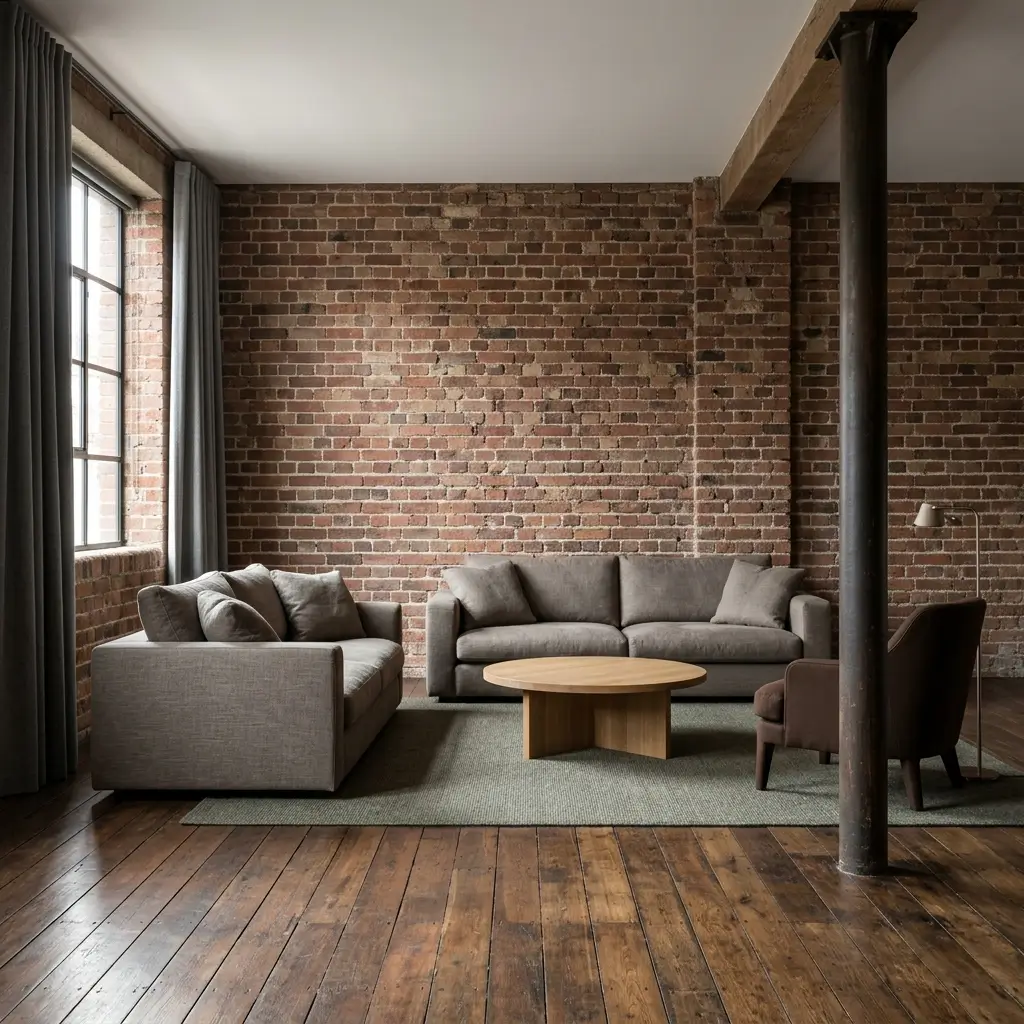
In a building where the original fabric survives, those materials deserve the leading role.
A wall of aged brick with genuine variation in tone and mortar, timber floorboards worn smooth over decades, and a patinated steel column carry the room’s history visibly.
Furnishing stays deliberately quiet: a simple linen sofa in warm gray, a round oak table with honest joinery, and plain wool curtains that filter light across the textured surfaces.
New elements are chosen for compatibility rather than imitation; nothing is distressed to match. Textiles and upholstery absorb sound and add comfort, allowing the eye to return to the brick and timber.
The design principle is restraint: provenance cannot be manufactured, so what exists is displayed with care.
11. Industrial Style Without Exposed Brick
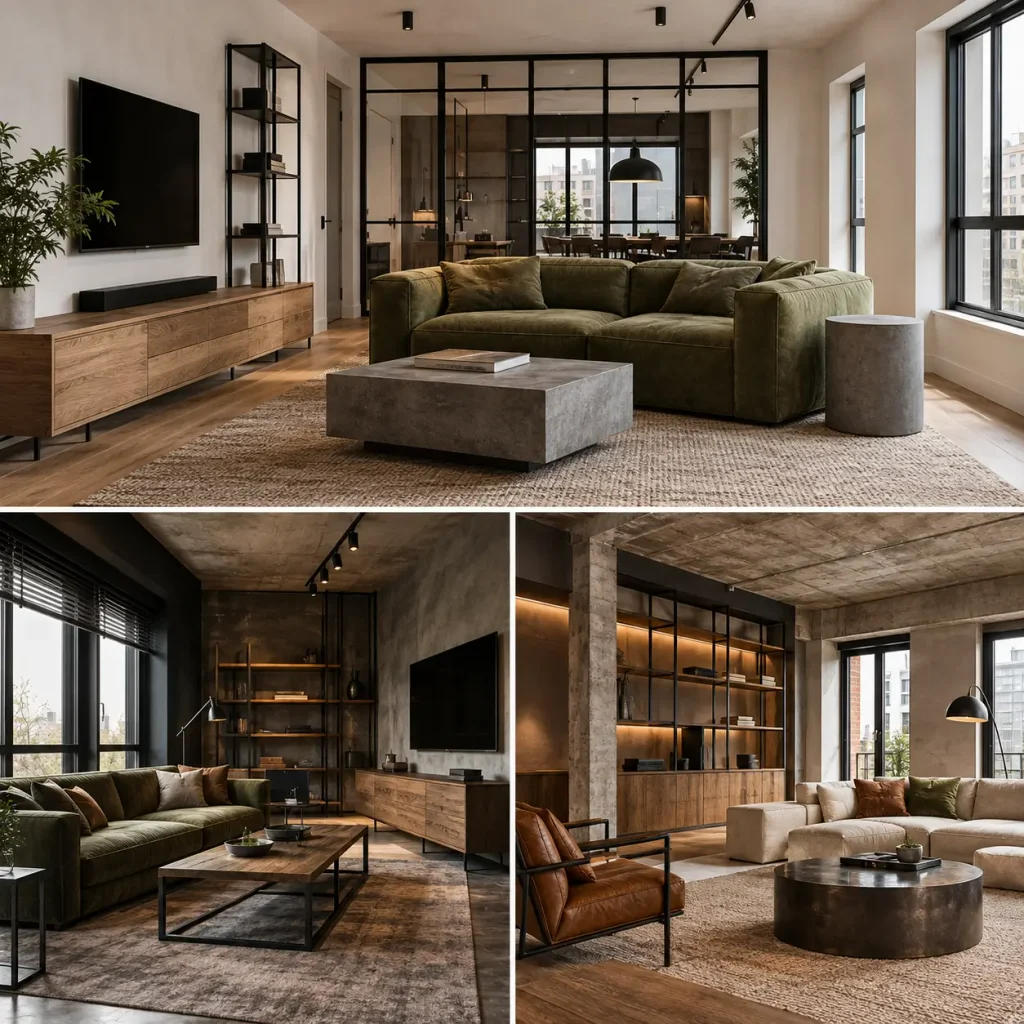
Industrial character does not require exposed brick. A conventional apartment with smooth plaster walls can establish the style through carefully selected materials and architectural details.
A concrete-effect floor introduces a continuous, utilitarian surface. Steel-and-glass shelving with visible fixings reveals how the structure is assembled, and a slim steel picture rail with precisely aligned joinery reinforces the room’s clean geometry.
Existing windows, ceiling finishes, and room proportions can remain intact. The industrial identity comes from the considered use of metal, surface finishes, structural details, and functional furniture.
This approach suits homes where industrial character needs to work within an ordinary residential interior without major structural alterations.
12. Experimental Industrial with Bold Contrasts
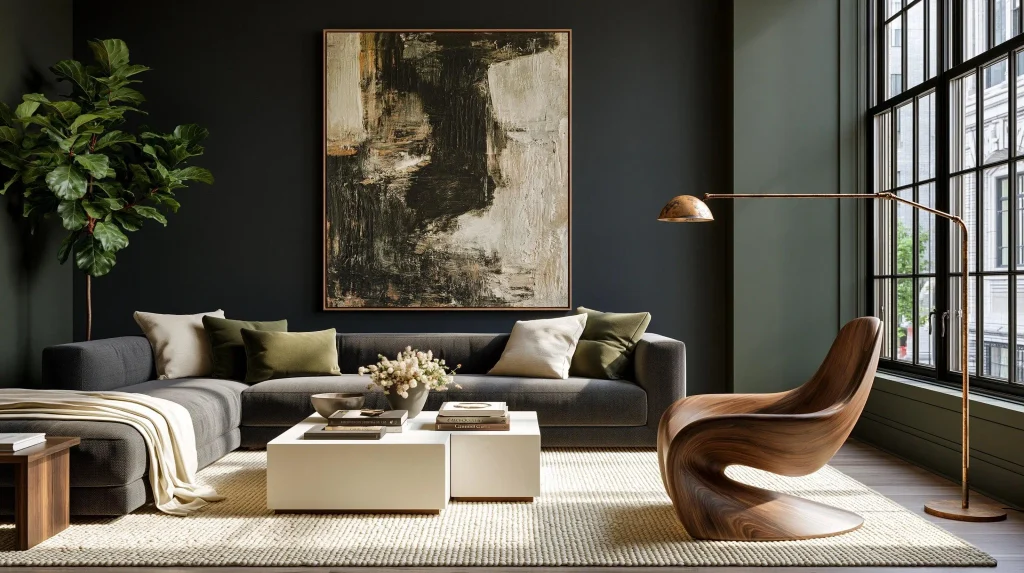
Exploring unexpected relationships between color, texture, shape, and finish defines experimental industrial design.
Saturated hues might be paired with raw concrete, while polished metallic surfaces sit against rugged timber forms.
The composition relies on a deliberate design rationale, ensuring that unconventional pairings feel purposeful rather than chaotic.
This approach pushes the boundaries of traditional industrial styling, proving that the aesthetic can accommodate daring artistic risks when managed through careful proportion, balanced visual weight, and precise spatial composition.
How to Bring Industrial Style into Your Living Room
The right approach depends on the room you actually have.
Ceiling height, natural light, floor finish, and existing architectural features all point toward different interpretations.
A compact apartment with standard proportions often responds best to material contrast and functional detailing, where a volume with visible structure can carry a darker palette or a more restrained scheme.
You do not need exposed brick or visible ductwork. In an ordinary home, industrial character comes from honest materials used coherently – a concrete or timber floor, steel-framed furniture, purposeful geometry, and a disciplined relationship between rough and smooth finishes.
Choose one design priority, such as structure, color, or craftsmanship, and let it govern the decisions that follow.
FAQs
Q1. What defines an industrial-style living room?
Industrial living rooms are defined by honest materials, visible or suggested structure, and functional furniture forms. Steel, concrete, timber, and plaster typically play prominent roles, and the palette often leans on neutrals – though none of this is mandatory.
What matters most is coherence: the architecture, finishes, and furnishings should feel related by a clear design logic.
Q2. Can I create an industrial living room in a normal house or apartment?
Yes. Most industrial interiors exist in conventional homes.
Without brick walls or factory windows, focus on material contrast and structural clarity: a concrete-effect floor, steel shelving with visible fixings, simple geometry, and functional furniture can establish the character convincingly without any structural alteration.
Q3. How do I add color to an industrial living room?
Color works best at scale in industrial spaces. Rather than confining it to accessories, consider a painted wall, a substantial upholstered sofa, or cabinetry in a coherent hue such as cobalt, emerald, or ochre.
Keep the architectural elements neutral so the color reads as an organizing principle of the design.
Q4. How can an industrial living room feel comfortable?
Comfort comes from layering and proportion. Deep, well-upholstered seating, rugs that soften hard floors, curtains that manage light and acoustics, and lighting at multiple heights all make a difference.
Combining industrial materials with tailored or traditional furniture also introduces warmth without weakening the style’s character.
Conclusion
Industrial living room design extends well beyond the familiar formula of brick, black metal, and worn leather.
The twelve directions here – color-led, traditional, sculptural, minimal, heritage-driven, and deliberately experimental – share one principle: the most convincing industrial interiors grow from a specific relationship between architecture, materials, furniture, and intent.
Identify your room’s strongest asset, whether that is its volume, its light, or simply its proportions, and build your interpretation around it.